
TeachUcomp, Inc.

 MY CART
  • VIDEO COURSES
    • All-Access Subscriptions
    • Business Licensing
    • Course List
      • Accounting
      • Adobe
        • Acrobat
        • Lightroom Classic
        • Photoshop
        • Photoshop Elements
      • Crystal Reports
      • Employment Skills
        • Interview Skills
        • Resume Skills
      • For Lawyers
        • Excel for Lawyers
        • Outlook for Lawyers
        • QuickBooks for Lawyers
        • Word for Lawyers
      • HTML
      • JavaScript
      • Microsoft Office
        • Access
        • Excel
        • Microsoft Office Suite
        • OneNote
        • Outlook
        • Outlook on the Web
        • PowerPoint
        • Publisher
        • Word
      • Microsoft Project
      • Microsoft Teams
      • QuickBooks Online
      • QuickBooks Pro
      • Sage
        • Peachtree
        • Sage 50
      • SQL
      • Windows
    • My Courses
    • Video Course Options
  • SUBSCRIPTIONS
  • MANUALS
    • Adobe
      • Acrobat
      • Lightroom Classic
      • Photoshop
      • Photoshop Elements
    • Crystal Reports
    • For Lawyers
      • Excel for Lawyers
      • Outlook for Lawyers
      • QuickBooks for Lawyers
      • Word for Lawyers
    • HTML
    • JavaScript
    • Microsoft Office
      • Access
      • Excel
      • OneNote
      • Outlook
      • Outlook on the Web
      • PowerPoint
      • Publisher
      • Word
    • Microsoft Project
    • Microsoft Teams
    • QuickBooks Online
    • QuickBooks Pro
    • Sage
      • Peachtree
      • Sage 50
    • SQL
    • Windows
  • BOOKS
    • QuickBooks Online
  • REFERENCE CARDS
    • Adobe
      • Acrobat
      • Lightroom Classic
      • Photoshop
      • Photoshop Elements 2026
      • Photoshop Elements 2025
      • Photoshop Elements 2024
      • Photoshop Elements 2023
      • Photoshop Elements 2022
      • Photoshop Elements 2021
      • Photoshop Elements 2020
      • Photoshop Elements 2019
      • Photoshop Elements 2018
      • Photoshop Elements 15
    • Chrome OS
      • Chrome OS Keyboard Shortcuts
    • FreshBooks
    • Google
      • Google Classroom for Teachers
      • Google Docs
      • Google Drive
      • Google Forms
      • Google Sheets
      • Google Slides
    • macOS
      • macOS Keyboard Shortcuts
      • macOS Tahoe
    • Microsoft Office
      • Excel Formulas and Functions
      • Excel Keyboard Shortcuts (macOS)
      • Excel Keyboard Shortcuts (PC/Windows)
      • Excel Tables PivotTables and Charts
      • Microsoft 365
        • Access for Microsoft 365
        • Excel for Microsoft 365
        • Microsoft Office 365
        • Outlook for Microsoft 365 Classic Edition
        • Outlook for Microsoft 365 (New Outlook)
        • PowerPoint for Microsoft 365
        • Publisher for Microsoft 365
        • Word for Microsoft 365
      • Microsoft Office 2021
        • Access 2021
        • Excel 2021
        • Microsoft Office 2021
        • OneNote for Windows 10
        • Outlook 2021
        • PowerPoint 2021
        • Publisher 2021
        • Word 2021
      • Microsoft Office 2019
        • Access 2019
        • Excel 2019
        • Microsoft Office 2019
        • Outlook 2019
        • PowerPoint 2019
        • Publisher 2019
        • Word 2019
      • Microsoft Office 2016
        • Access 2016
        • Excel 2016
        • Microsoft Office 2016
        • OneNote 2016
        • Outlook 2016
        • PowerPoint 2016
        • Publisher 2016
        • Word 2016
      • Microsoft Office 2013
        • Excel 2013
        • Microsoft Office 2013
        • OneNote 2013
        • Outlook 2013
        • PowerPoint 2013
        • Word 2013
      • Microsoft Office for iPad
        • Microsoft Office for iPad
      • Word Keyboard Shortcuts (PC/Windows)
    • Microsoft Teams
    • QuickBooks Online
    • QuickBooks Pro
      • QuickBooks Pro 2024
      • QuickBooks Pro 2023
      • QuickBooks Pro 2022
      • QuickBooks Pro 2021
      • QuickBooks Pro 2020
      • QuickBooks Pro 2019
      • QuickBooks Pro 2018
      • QuickBooks Pro 2017
      • QuickBooks Pro 2016
      • QuickBooks Pro 2015
      • QuickBooks Pro 2014
    • Sage 50 Accounting
    • SQL
    • Windows
      • Windows 11
      • Windows 11 and 10 Keyboard Shortcuts
      • Windows 10
  • STICKERS
    • Chrome OS
    • macOS
    • Microsoft Office
      • Word and Excel (Mac)
      • Word and Excel (PC/Windows)
    • QuickBooks Desktop
      • QuickBooks Desktop (PC/Windows) 2024
      • QuickBooks Desktop (PC/Windows) 2023
      • QuickBooks Desktop (PC/Windows) 2022-2015
    • QuickBooks Online
    • Windows
  • SUPPORT
    • Company
      • About Us
      • Blog
      • Contact Us
      • Our History
      • Our Philosophy
        • Customer Service
        • Mission
      • Policies
      • Testimonials
    • FAQ
      • Contact Us
    • Help
    • Lost Password
    • Register a Product
  • LOGIN
    • Manage My Account
    • Member Login
    • My Courses
Shop Now

The Color Grading Panel in Camera Raw in Photoshop – Instructions

by Joseph Brownell / Wednesday, September 20 2023 / Published in Latest, Photoshop

Video Lesson:

            This video lesson, titled “Learn How to Use Color Grading in Camera Raw in Adobe Photoshop: A Training Tutorial,” shows how to apply a color using the Color Grading panel in Camera Raw in Photoshop. This video lesson is from our complete Photoshop tutorial, titled “Mastering Photoshop Made Easy.”

Overview:

            The Color Grading panel in the Camera Raw dialog box in Photoshop lets you apply color either globally or to only selected tonal ranges in a camera raw image. You can apply color using the Color Grading panel to either color or black and white images, depending on the desired effect you want to achieve in the camera raw photo. You can control the hue, saturation, and luminance of the color you apply.

            To show the Color Grading panel in the Camera Raw dialog box in Photoshop, click the “Edit” button in the toolbar at the right side of the Camera Raw dialog box, if needed. Then click the “Color Grading” tab in the Edit panel that appears to the left of the toolbar to expand it, if needed.

How to Select the Tonal Range to Adjust Using the Color Grading Panel in Camera Raw in Photoshop:

            Then select to which tonal ranges in the camera raw photo to apply a color by clicking the button to the right of the “Adjust” label at the top of the Color Grading panel for the desired tonal range or ranges to show below it. Selecting the “3-Way” button shows three separate color circles for “Midtones,” “Shadows,” and “Highlights.” Selecting either the “Shadows,” “Midtones,” or “Highlights” button shows only the color circle for the selected tonal range. Alternatively, selecting the “Global” button shows one circle for all tonal ranges.

How to Adjust a Selected Tonal Range Using the Color Grading Panel in Camera Raw in Photoshop:

            To apply the color to the selected tonal range, click and drag in its color circle to set its hue and saturation values. After setting the desired hue and saturation, then use the “Luminance” slider below the color circle to set the color’s desired luminance value.

            If viewing an individual color circle in the Color Grading panel, you can also use sliders to set the desired hue and saturation values by clicking the arrow button towards the lower-right corner of the circle, above the “Luminance” slider, to expand it and show the “Hue” and “Saturation” sliders. You can then use the sliders to set each slider’s value or type a value into its adjacent field. The color you select is then applied to the selected tonal range in the camera raw image.

            To adjust how the Color Grading blends and overlaps between tonal ranges, use the “Blending” slider at the bottom of the Color Grading tab or type a value into its adjacent field. Lower values provide more tonal range separation and higher values cause more tonal range overlap. To adjust the Color Grading balance between the lighter and darker colors, use the “Balance” slider or enter a value into its field. Sliding to the left or using negative values emphasizes shadows and sliding right or using positive values emphasizes highlights.
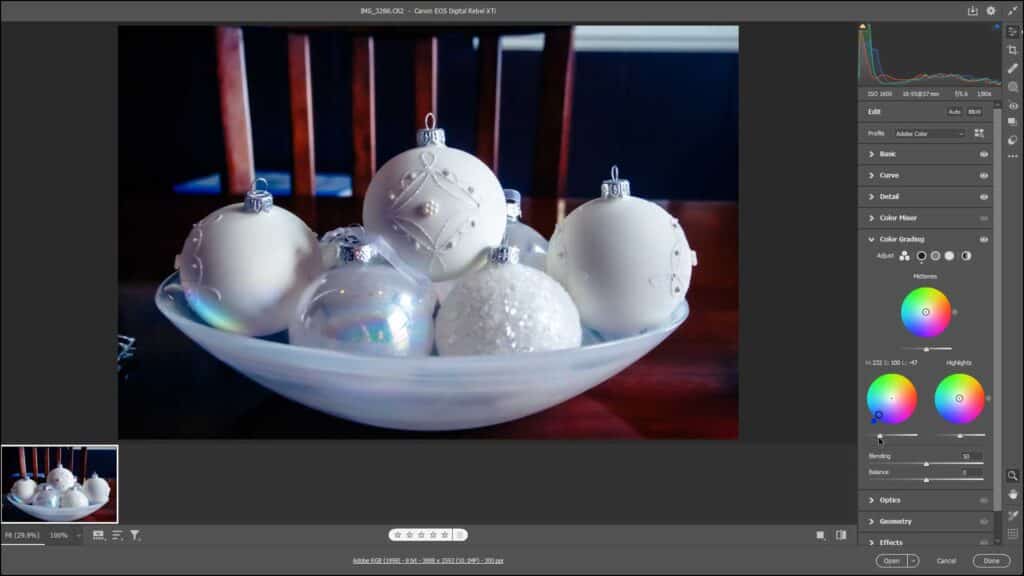
A picture of a user applying a color to a selected tonal range using the Color Grading panel in Camera Raw in Photoshop.

A picture of a user applying a color to a selected tonal range using the Color Grading panel in Camera Raw in Photoshop.

How to Hide Color Grading Adjustments:

            To temporarily hide all Color Grading panel adjustments in the preview image after changing these settings, click and hold down on the “eye” icon in the upper-right corner of the “Color Grading” tab in the Edit panel. This temporarily hides the changes in the preview image while you hold down on this icon. Simply release the mouse button to restore the visibility of the changes.

Instructions on How to Use the Color Grading Panel in Camera Raw in Photoshop:

  1. To show the Color Grading panel in the Camera Raw dialog box in Photoshop, click the “Edit” button in the toolbar at the right side of the Camera Raw dialog box, if needed.
  2. Then click the “Color Grading” tab in the Edit panel to the left of the toolbar to expand it, if needed.

How to Select the Tonal Range to Adjust Using the Color Grading Panel:

  1. To select to which tonal ranges in the camera raw photo to apply a color, click the button to the right of the “Adjust” label at the top of the Color Grading panel for the desired tonal range or ranges to show below it.
  2. Selecting the “3-Way” button shows separate color circles for “Midtones,” “Shadows,” and “Highlights.”
  3. Selecting either the “Shadows,” “Midtones,” or “Highlights” button shows only the color circle for the selected tonal range.
  4. Alternatively, selecting the “Global” button shows one circle for all tonal ranges.

Instructions on How to Adjust a Selected Tonal Range Using the Color Grading Panel:

  1. To apply a color to the selected tonal range, click and drag in its color circle to set its hue and saturation values.
  2. After setting the desired hue and saturation, then use the “Luminance” slider below the color circle to set the color’s desired luminance value.
  3. If viewing an individual color circle in the Color Grading panel, you can also use sliders to set the desired hue and saturation values by clicking the arrow button towards the lower-right corner of the circle, above the “Luminance” slider, to expand it and show the “Hue” and “Saturation” sliders.
  4. You can then use the sliders to set each slider’s value or type a value into its adjacent field.
  5. The color you select is then applied to the selected tonal range in the camera raw image.
  6. To adjust how the Color Grading blends and overlaps between tonal ranges, use the “Blending” slider at the bottom of the Color Grading tab or type a value into its adjacent field. Lower values provide more tonal range separation and higher values cause more tonal range overlap.
  7. To adjust the Color Grading balance between the lighter and darker colors, use the “Balance” slider or enter a value into its field. Sliding to the left or using negative values emphasizes shadows and sliding right or using positive values emphasizes highlights.

Instructions on How to Temporarily Hide Color Grading Adjustments:

  1. To temporarily hide all Color Grading panel adjustments in the preview image after changing these settings, click and hold down on the “eye” icon in the upper-right corner of the “Color Grading” tab in the Edit panel.
  2. To restore the visibility of the changes, then release the mouse button.
Tagged under: add a color to a tonal range, adjust the color in a tonal range in camera raw in photoshop, apply a color to a tonal range in camera raw in photoshop, balance, blending, camera raw file, camera raw files, camera raw image, camera raw images, camera raw in photoshop, color grading panel, color grading panel in camera raw in photoshop, course, edit, editing, global, help, highlights, how-to, hue, instructions, learn, lesson, luminance, midtones, overview, photoshop, saturation, shadows, sliders, teach, tonal range, tonal ranges, training, tutorial, video

About Joseph Brownell

Joseph Brownell is founder and Vice President of TeachUcomp, Inc. He is the author of dozens of titles across the TeachUcomp, Inc. product line.
Sale! One Year Online Entire Library $29. Click here to see the deals.


Photoshop Quick Reference Guide. Buy Now.
 

Categories

  • GET SOCIAL

© 2001-2026 Copyright TeachUcomp, Inc. All rights reserved.

TOP
SALE! $29 All-Access 1 Days 19 Hours 10 Minutes 58 Seconds      $199 $29 Entire Library!
See Deal